PETER BEYLS ~ IT ALWAYS TAKES A SHORT TIME (1975) / IN FLIGHT CONTROL (1983)

LP (180 Gram)
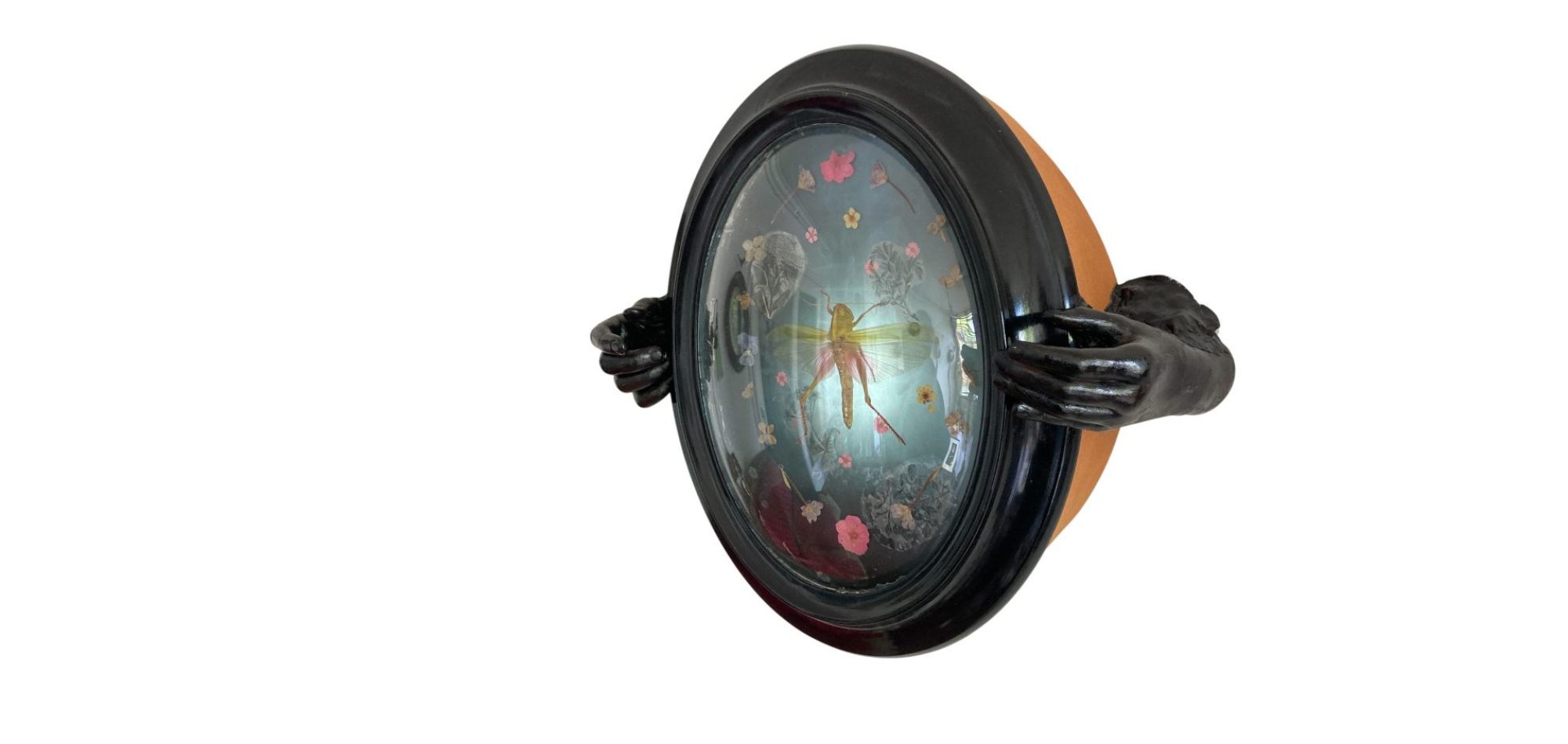
Original Artwork by Peter Beyls
Numbered & signed edition of 25 ex.
d’or063


This is the third publication dedicated fully to the work of Belgian early electronic composer Peter Beyls (1950).

Included here is the tape-only part of It Always Takes a Short Time, an intermedia performance piece involving live narration, slide projection and music on tape [1]. The tape-music composition was produced at the IPEM Studio in Ghent and developed from a short text by my late friend conceptual artist Yves De Smet (1946-2004). The text runs as follows: “When two trains are standing next to each other and one of them starts, it always takes a short time before I realize whether it is, mine or the other”.

It Always Takes a Short Time is a 4-channel piece constructed as two individual 2-track tapes playing in sync. It includes elements of text-sound composition borrowing spoken fragments from the source text as recited by Herman Sabbe. In addition, much material is generated by a crackle-box; a small portable electronic music instrument I designed and built at STEIM, Amsterdam in Spring 1973 [2]. All source material was manually organized by cutting and splicing fragments from multiple audio tapes.

[1] Premiere performance at Museum Dhondt-Dhaenens, Deurle, Belgium, 1975 Narrator: Herman Sabbe.

[2] Cracklebox, https://steim.org/cracklebox/


In Flight Control
is a live electronics piece, it was first performed at De Zwarte Zaal, PROKA Ghent in 1983.

During a flight from California to the US east coast in 1981, a conversation between the pilot and the control tower was recorded using a small portable tape recorder. Correspondingly, a conversational performance strategy developed: performer and instrument engaged in a tight musical dialogue. In this type of performance practice, one first designs a musical instrument; a system created out of a number of electronic modules all connected into a particular complex patch. Such systems exhibit some form of sonic character, a specific behavioral scope as implied in a given patch. The performer interacts in a conversation-like setting while the system unfolds its musical character over time. Serge Tcherepnin whom I had just visited in San Francisco designed and built the modular voltage-controlled synthesizer used in the performance of In Flight Control [1].

Peter Beyls
Ghent, January 26, 2022

[1] Serge Modular Systems: http://serge.synth.net/

Peter Beyls works on the intersection of computer science and the arts. He develops generative systems in music, the visual arts and hybrid formats. Beyls studied music and computer science at EMS, Stockholm, the Royal Music Conservatory, Brussels and the Slade School of Art, UC London. He was a researcher at ICCMR and was awarded a PhD in Computer Science from the University of Plymouth UK, for his research on evolutionary computing applied to real-time interactive music systems. He published extensively on various aspects of digital media, in particular, real-time interactive music systems, generative art and, in general, the application of Artificial Intelligence for artistic purposes.

Beyls pioneered the use of cellular automata in the field of computer music while at the VUB AI-Lab. His work was widely exhibited and performed at conferences like Siggraph, ICMC, Imagina, ISCM, Generative Arts and ISEA. He was invited professor at a.o. the University of Quebec, Montreal, California Institute of the Arts, Shanghai Institute of Visual Arts, the School of Visual Arts, New York and the Osaka Arts University, Japan. Until September 2016, he was a research professor at CITAR, Catholic University of Portugal, Porto. He is currently a visiting researcher at the Department of Media Art, University College Ghent, specifically developing a project at KASK Laboratory aiming to interface aesthetic and biological processes. Beyls is also a is a visiting professor at Artec, University Paris VIII Vincennes-Saint Denis, Paris, France.

Peter Beyls has been involved with ISEA (the International Symposium on Electronic Art) since the early 1990’s, he is currently a member of the IIAC (ISEA International Advisory Committee). In addition, he is an associate with Ear to the Earth, New York, Intermedia Projects, Albuquerque, NM and the Algorists collective.

Beyls was initially active in electronic music, as a composer of tape music. Later on, he developed various analog live electronic music systems. In close partnership with Michel Waisvisz, he designed and built the early prototypes of the crackle box synthesizer at STEIM, Amsterdam (1973-1975). While teaching at the Vrije Academie/Psychopolis, The Hague, Beyls develops various collaborative projects with Dutch experimental filmmaker Hero Wouters. Around the same time, Karel Goeyvaerts and Lucien Goethals were his mentors at the IPEM Studio, Ghent. In the mid 1990s Beyls performs extensively in a trio with John Van Rymenent and Geoff Leigh. Over the years, Beyls’ engagement with music systems evolved from home-made electronics to time-sharing computers to laptop performance.

Beyls conceives of computer media as active partners in a creative process, a methodology he refers to as “conceptual navigation”. Software is written in order to explore ambiguous intentions. Once an idea is formalized in a program, one can evaluate its imaginative potential by way of the feedback that program provides. Since a program reflects the objectives of the artist, programming is considered a method of aesthetic introspection. Software is thus instrumental as a functional, materialist means allowing the active manipulation of otherwise purely conceptual constructs.

Over the years, Beyls’ work has primarily centered on generative systems, including extensive series of machine drawings, human-machine interactive music systems using machine-learning and interactive audiovisual installations, many of them using computer-vision. A clear line of thought underpins the evolution of his artistic thinking: from methodologies borrowed from conventional AI (knowledge-based systems) to Artificial Life oriented systems exploring the notion of emergent functionality. An experimental, exploratory attitude is core to his work.

Beyls is equally fascinated by the problem of translating digital/virtual artifacts back into the tangible analog world as to make them available for humans to be experienced. This raises questions of how digital art is connected to the sensual parameters of human physicality and how it can be referenced/understood from the whole of human culture and the massive depth of its history. A monograph documenting his oeuvre was published by MER Paperkunsthalle in 2014. The event coincided with a major survey exhibition at IMAL, Center for Digital Culture, Brussels. A more recent collection of texts entitled Coming Full Circle, (2019) was published by the Verbeke Foundation Belgium following a solo show at the Verbeke Museum. Beyls’ work is represented by Gallery DAM, Berlin, Germany.

Ever changing Animation by Peter Beyls
https://www.peterbeyls.net/SPO_01.html

Website Peter Beyls


a side
– It Always Takes A Short Time (1975).
b side
– In Flight Control (1983).

All Music by Peter Beyls

Peter Beyls ~ It Always Takes A Short Time (1975) (Excerpt)
Peter Beyls ~ In Flight Control (1983) (Excerpt)

Artwork Description:
A series of 5 unique pen plotter drawings on chromogenetic prints, each in an edition of 5.
298-298 cm. Gatefold cardboard cover with green sticker.

Serie 1, Edition of 5.
Serie 2, Edition of 5.
Serie 3, Edition of 5.
Serie 4, Edition of 5.
Serie 5, Edition of 5.

PETER BEYLS ~ ROTHKO (1977)

LP (180 Gram)
Original Artwork by Peter Beyls
Numbered & signed edition of 25 ex.
d’or062


This is the second publication dedicated fully to the work of Belgian early electronic composer Peter Beyls (1950).

Rothko is a tape-music composition produced at the Expanded Media Studio, Brussels – a personal electronic music studio established at the time by my late friend, pioneering experimental jazz musician John Van Rymenant (1942-2018) and myself. Musical material gathered in the studio was manually assembled by cutting and splicing multiple audiotapes. The final mixdown took place at the IPEM Studio in Ghent.

A fascination with the work of American color-field painter Mark Rothko exemplifies the title of this piece. In 1952, he wrote: “The most important tool the artist fashions through constant practice is faith in his ability to produce miracles when they are needed” [1].

Never having any intention to translate Rothko’s pictural language into sound, the connection was an affective one as reflected in the immersive, embodied experience of color itself. Expressive timbral articulation is key to the piece – close listening entails an immersive experience emphasizing the organic quality of sound. As Rothko asserted: “I paint big to be intimate” [2].

Peter Beyls
Ghent, January 25, 2022

[1] Rothko, Mark: (1947) in: Possibilities, Vol. 1, no. 1, Winter 1947-48, Wittenbron Schultz, Inc. New York, NY, pp. 85

[2] Rothko, Mark: The Artist’s Reality: Philosophies of Art, Yale University Press, New Haven, CT. A seminal text written by Rothko during 1940 – 1941, discovered in 2000 and ultimately published in 2004.

Peter Beyls works on the intersection of computer science and the arts. He develops generative systems in music, the visual arts and hybrid formats. Beyls studied music and computer science at EMS, Stockholm, the Royal Music Conservatory, Brussels and the Slade School of Art, UC London. He was a researcher at ICCMR and was awarded a PhD in Computer Science from the University of Plymouth UK, for his research on evolutionary computing applied to real-time interactive music systems. He published extensively on various aspects of digital media, in particular, real-time interactive music systems, generative art and, in general, the application of Artificial Intelligence for artistic purposes.

Beyls pioneered the use of cellular automata in the field of computer music while at the VUB AI-Lab. His work was widely exhibited and performed at conferences like Siggraph, ICMC, Imagina, ISCM, Generative Arts and ISEA. He was invited professor at a.o. the University of Quebec, Montreal, California Institute of the Arts, Shanghai Institute of Visual Arts, the School of Visual Arts, New York and the Osaka Arts University, Japan. Until September 2016, he was a research professor at CITAR, Catholic University of Portugal, Porto. He is currently a visiting researcher at the Department of Media Art, University College Ghent, specifically developing a project at KASK Laboratory aiming to interface aesthetic and biological processes. Beyls is also a is a visiting professor at Artec, University Paris VIII Vincennes-Saint Denis, Paris, France.

Peter Beyls has been involved with ISEA (the International Symposium on Electronic Art) since the early 1990’s, he is currently a member of the IIAC (ISEA International Advisory Committee). In addition, he is an associate with Ear to the Earth, New York, Intermedia Projects, Albuquerque, NM and the Algorists collective.

Beyls was initially active in electronic music, as a composer of tape music. Later on, he developed various analog live electronic music systems. In close partnership with Michel Waisvisz, he designed and built the early prototypes of the crackle box synthesizer at STEIM, Amsterdam (1973-1975). While teaching at the Vrije Academie/Psychopolis, The Hague, Beyls develops various collaborative projects with Dutch experimental filmmaker Hero Wouters. Around the same time, Karel Goeyvaerts and Lucien Goethals were his mentors at the IPEM Studio, Ghent. In the mid 1990s Beyls performs extensively in a trio with John Van Rymenent and Geoff Leigh. Over the years, Beyls’ engagement with music systems evolved from home-made electronics to time-sharing computers to laptop performance.

Beyls conceives of computer media as active partners in a creative process, a methodology he refers to as “conceptual navigation”. Software is written in order to explore ambiguous intentions. Once an idea is formalized in a program, one can evaluate its imaginative potential by way of the feedback that program provides. Since a program reflects the objectives of the artist, programming is considered a method of aesthetic introspection. Software is thus instrumental as a functional, materialist means allowing the active manipulation of otherwise purely conceptual constructs.

Over the years, Beyls’ work has primarily centered on generative systems, including extensive series of machine drawings, human-machine interactive music systems using machine-learning and interactive audiovisual installations, many of them using computer-vision. A clear line of thought underpins the evolution of his artistic thinking: from methodologies borrowed from conventional AI (knowledge-based systems) to Artificial Life oriented systems exploring the notion of emergent functionality. An experimental, exploratory attitude is core to his work.

Beyls is equally fascinated by the problem of translating digital/virtual artifacts back into the tangible analog world as to make them available for humans to be experienced. This raises questions of how digital art is connected to the sensual parameters of human physicality and how it can be referenced/understood from the whole of human culture and the massive depth of its history. A monograph documenting his oeuvre was published by MER Paperkunsthalle in 2014. The event coincided with a major survey exhibition at IMAL, Center for Digital Culture, Brussels. A more recent collection of texts entitled Coming Full Circle, (2019) was published by the Verbeke Foundation Belgium following a solo show at the Verbeke Museum. Beyls’ work is represented by Gallery DAM, Berlin, Germany.


Website Peter Beyls


a side
– Rothko Part I.
b side
– Rothko Part II.

All Music by Peter Beyls

Peter Beyls ~ Rothko (1977) (Excerpt)

Artwork Description:
A series of 5 unique pen plotter drawings on chromogenetic prints, each in an edition of 5.
298-298 cm. Gatefold cardboard cover with blue sticker.

Series 1. Edition of 5.
Series 2. Edition of 5.
Series 3. Edition of 5.
Series 4. Edition of 5.
Series 5. Edition of 5.

RAYASTRE ~ BRUIT DE TRIOLET…

Installation by Rayastre
Rayastre ~ Para Brahma
LP AND ARTWORK IN BOX
PUBLICATION OCTOBER 6
(Photo of Installation by Rayastre)

LP (180 Gram)
Original Artwork by Rayastre
Numbered & signed edition of 25 ex.
d’or061

  1. Claquement Bruit…
  2. Rhytme Sinusale…
  3. Extrasystole Sporadique…
  4. Bruit du Cœur…
  5. Éclat Variable…
  6. L’écume du Ciel…
  7. Dédoublement du deuxième bruit……
  8. Gallop Presystolique…
  9. Bruit de Triolet…
  10. Claquement d’ouverture Mitrale…
  11. Le souffle Systolique…
  12. Le souffle Discret…
  13. Souffle Proto Systolique…
  14. Le Souffle du Rêve…
  15. Souffle Gastolique…
  16. le souffle continue de la persistance du canal artériel rappelle de la locomotive…

All Music by Rayastre…
All Music made with Voice and Tape Manipulation Only.

“The Music celebrates the different Forms and Deviations of Heart Murmur. Cardiac Auscultation in full Exclamation…” (Rayastre)

Rayastre ~ Claquement Bruit…
Rayastre ~ Rhytme Sinusale…
Rayastre ~ Extrasystole Sporadique…

Listen to full album here: https://astresdor.bandcamp.com/album/rayastre-para-brahma

Artwork Description
The following collages were made by Rayastre during the course of several years. The original collages are transparent collages on lightboxes. All etchings are direct transfers from original 19th century books. The transfer procédé is a unique technique developed by Rayastre and involves careful washing with water and transfer to adhesive tape. There is no computer or copymachine used in this process, but is fully done by hand.
These 5 prints are blow ups (30-30 cm) of the originals (10-10 cm) on a transparent plastic sheet. A unique series of 5 prints of five collages in first (and last) edition. Signed by the artist.
Hardcover box with black linen and wooden dowel.

Rayastre Website

Series 1. Edition of 5 Original Prints
Series 2. Edition of 5 Original Prints
Series 3. Edition of 5 Original Prints
Series 4. Edition of 5 Original Prints
Series 5. Edition of 5 Original Prints
Series 2 on hardcover box
Innercover
Innercover with 4 prints
Series 2 print on transparent plastic sheet
Series 2, transparent sheet

PETER BEYLS ~ THE HOLLOW MAN (1980)

LP (180 Gram)
Original Artwork by Peter Beyls
Numbered & signed edition of 25 ex.
d’or060


This is the first publication dedicated fully to the work of Belgian early electronic composer Peter Beyls (1950).
Previously, his music was published as part of compilations of the IPEM institute (Institute for Psycho-acoustic and Electronic Music), released by Metaphon and Creel Pone.

This work is among the very first computer generated pieces, composed, performed and recorded in 1980 at Vorst Nationaal, Nacht van de Poëzie (Night of the Poetry) in Brussels, Belgium.

Peter Beyls works on the intersection of computer science and the arts. He develops generative systems in music, the visual arts and hybrid formats. Beyls studied music and computer science at EMS, Stockholm, the Royal Music Conservatory, Brussels and the Slade School of Art, UC London. He was a researcher at ICCMR and was awarded a PhD in Computer Science from the University of Plymouth UK, for his research on evolutionary computing applied to real-time interactive music systems. He published extensively on various aspects of digital media, in particular, real-time interactive music systems, generative art and, in general, the application of Artificial Intelligence for artistic purposes.

Beyls pioneered the use of cellular automata in the field of computer music while at the VUB AI-Lab. His work was widely exhibited and performed at conferences like Siggraph, ICMC, Imagina, ISCM, Generative Arts and ISEA. He was invited professor at a.o. the University of Quebec, Montreal, California Institute of the Arts, Shanghai Institute of Visual Arts, the School of Visual Arts, New York and the Osaka Arts University, Japan. Until September 2016, he was a research professor at CITAR, Catholic University of Portugal, Porto. He is currently a visiting researcher at the Department of Media Art, University College Ghent, specifically developing a project at KASK Laboratory aiming to interface aesthetic and biological processes. Beyls is also a is a visiting professor at Artec, University Paris VIII Vincennes-Saint Denis, Paris, France.

Peter Beyls has been involved with ISEA (the International Symposium on Electronic Art) since the early 1990’s, he is currently a member of the IIAC (ISEA International Advisory Committee). In addition, he is an associate with Ear to the Earth, New York, Intermedia Projects, Albuquerque, NM and the Algorists collective.

Beyls was initially active in electronic music, as a composer of tape music. Later on, he developed various analog live electronic music systems. In close partnership with Michel Waisvisz, he designed and built the early prototypes of the crackle box synthesizer at STEIM, Amsterdam (1973-1975). While teaching at the Vrije Academie/Psychopolis, The Hague, Beyls develops various collaborative projects with Dutch experimental filmmaker Hero Wouters. Around the same time, Karel Goeyvaerts and Lucien Goethals were his mentors at the IPEM Studio, Ghent. In the mid 1990s Beyls performs extensively in a trio with John Van Rymenent and Geoff Leigh. Over the years, Beyls’ engagement with music systems evolved from home-made electronics to time-sharing computers to laptop performance.

Beyls conceives of computer media as active partners in a creative process, a methodology he refers to as “conceptual navigation”. Software is written in order to explore ambiguous intentions. Once an idea is formalized in a program, one can evaluate its imaginative potential by way of the feedback that program provides. Since a program reflects the objectives of the artist, programming is considered a method of aesthetic introspection. Software is thus instrumental as a functional, materialist means allowing the active manipulation of otherwise purely conceptual constructs.

Over the years, Beyls’ work has primarily centered on generative systems, including extensive series of machine drawings, human-machine interactive music systems using machine-learning and interactive audiovisual installations, many of them using computer-vision. A clear line of thought underpins the evolution of his artistic thinking: from methodologies borrowed from conventional AI (knowledge-based systems) to Artificial Life oriented systems exploring the notion of emergent functionality. An experimental, exploratory attitude is core to his work.

Beyls is equally fascinated by the problem of translating digital/virtual artifacts back into the tangible analog world as to make them available for humans to be experienced. This raises questions of how digital art is connected to the sensual parameters of human physicality and how it can be referenced/understood from the whole of human culture and the massive depth of its history. A monograph documenting his oeuvre was published by MER Paperkunsthalle in 2014. The event coincided with a major survey exhibition at IMAL, Center for Digital Culture, Brussels. A more recent collection of texts entitled Coming Full Circle, (2019) was published by the Verbeke Foundation Belgium following a solo show at the Verbeke Museum. Beyls’ work is represented by Gallery DAM, Berlin, Germany.


Website Peter Beyls

Peter Beyls at the performance of The Hollow Man at ‘festival voor elektronische muziek’, Plan K Brussel in 1980)

a side
– The Hollow Man Part I. (20:12 minutes)
b side
– The Hollow Man Part II. (20:12 minutes)

Live concert with computer, 1980.

All Music by Peter Beyls


Vorst Nationaal, Nacht van de Poëzie (Night of the Poetry) organized by Guido Lauwaert – openingperformance – 16 februari 1980
Mastering, vinylcut Astres d’Or

“(The Hollow Man) … was fully programmed – with 2 realtime inputs in parallel: (1) triggering certain functions via the computer keyboard and (2) manual manipulation of the VCF filters in the Oberheim 4 voice. The program generates evolving patterns – gradual transformations with algorithmic principles that I also used to make drawings. “

“In performance, it involves human-machine collaboration with shared initiative and an equivalent level of artistic autonomy. I also call it symbolic interaction – the difference between responsive systems and interactivity – documented in a recent paper – attached here for your information.” (PB)

“PET Commodore linked to the Oberheim – behind me Rudi Blondia, the designer of the interface” (PB)(festival voor elektronische muziek, Plan K Brussel in 1980)
Peter Beyls ~ The Hollow Man (excerpt Side A)
Peter Beyls ~ The Hollow Man (excerpt Side B)

Artwork Description:
A series of 5 unique pen plotter drawings on chromogenetic prints, each in an edition of 5.
298-298 cm.

Peter Beyls is part of a group called the “Algorists”, originally created by Jean-Pierre Hébert (who coined the word) and Roman Verostko. They stated that artists who create an object of art with a process that includes their own algorithms are identified as algorists. There are no more than 10 artists worldwide who pursued a career in this medium in combination with plotter drawings over the past 50 years. Beyls is amongst them. Pen plotters became less important after the year 2000, when newer printing methods gained momentum and were more effective. However, in recent years some younger artists started using affordable pen plotters again. After all, a drawn line, even if it is based on an algorithm, may have a different appeal than the slick appearance of an inkjet print.

Peter Beyls considers the act of drawing a “thinking machine”. Intrigued by the possibilities of computer-programming he created his first drawings in 1974 at Ghent University. He continued his research in algorithmic drawing in 1977 at the Slade School of Art in London and has never stopped since. Aesthetically he was interested in a wide range of concepts from basic geometric forms to organic structures which were usually executed in small series with variations.
This is his most recent series of drawings, from this year, 2022.

SBL Series 1, edition of 5
SBL Series 2, edition of 5
SBL Series 3, edition of 5
SBL Series 4, edition of 5
SBL Series 5, edition of 5

RAYASTRE ~ SHAMBHAVI MUDRA MALDOROR

LP (180 Gram)
Original Artwork by Rayastre
Numbered edition of 25 ex.
Signed by the Artist
d’or059

“All my work is closely related / connected to my journey into myself… It’s highly autobiographical in that sense, albeit in an abstract form. The music is a direct 1:1 result of the journey, not a depiction / reflection of the journey… The truth shines through a real experience, when the truth is touched. Although the materialisation of this psychic pathway, the music, is abstract, something of the initial experience will shine through…

The music for Shambhavi Mudra Maldoror is a direct result of my daily meditational practices. It is the meditation which was the centre. Not the music…
It carries at the same time all my experience as a human being and in particular a few life altering events. When one has touched the essence of being and has experienced how it is when there’s no self or even awareness… When one has experienced, yet has no memory of it because there was no Self… When one comes back slowly into the Self and finds oneself being just a tiny molecule in a wild cosmic stream of energy… The full immersion in the Para Brahma evaporates all boundaries between the Self and the Universe through it’s pure essence of bliss…” (Rayastre)

RAYASTRE ~ SHAMBHAVI MUDRA MALDOROR

Para Brahma I (20:25)
Para Brahma II (20:56)

All music Rayastre


Dedicated to Floris Sirag (* 5-4-1956 – † 25-9-2020) & Nynke Wesselius (* 9-9-1961 – † 18-10-2020)

OM RHAM HIRANYAGARBHAYA NAMAHA (Salute to the golden cosmic egg…)

_______________________________________________________________

Listen here to Rayastre ~ Shambhavi Mudra Maldoror, Para Brahma I (excerpt)


Listen here to Shambhavi Mudra Maldoror, Para Brahma II (excerpt)

____________________________________________________________

Artwork description:
Hardcover box with prints, LP and a nature’s memory…

  • Red velvet box (size 33-33 cm)
    -Front of box: print of photocollage “Vajrabhairava (path to samadhi) I”, golden ribbon with bell, red cotton flowers, golden tassel (size 30-30 cm)
    – Inside of front box: print of collage “Vajrabhairava (path to samadhi) II” (size 30-30 cm)
    – Inside of backside box: print of collage “Para Brahma III” (size 20-20 cm)
  • Content of box:
    – print of collage “Para Brahma I” (size 30-30 cm)(300 grams paper)
    – print of photocollage “Para Brahma II” (size 30-30 cm)(300 grams paper)
    – a nature’s memory (dried leaves and flowers as found and preserved by the artist)
    – LP handcut by the artist. Hand etchings on vinyl.

All artwork by Rayastre

2/25 front “Vajrabhairava (path to samadhi) I”
2/25 inside front (“Vajrabhairava (path to samadhi) II”) and backside first page
2/25 first page (“Para Brahma I”) and a nature’s memory
2/25 a nature’s memory and second page (“Para Brahma II”)
2/25 second page (“Para Brahma II”) and inside backside (“Para Brahma III”)
2/25 inside backside (“Para Brahma III”)
2/25 second page (“Para Brahma II”)
2/25 backside second page. Handwritten text, signature, place, date
2/25 a nature’s memory
2/25 first page (“Para Brahma I”)
2/25 inside front (“Vajrabhairava (path to samadhi) II”)
2/25 backside
Vajrabhairava (path to samadhi) I
Vajrabhairava (path to samadhi) II
Para Brahma I
Para Brahma II
Para Brahma III
SOLD
Payment Options: Paypal or Creditcard
SOLD
Payment Options: Paypal or Creditcard

KLAUS RÖDER ~ PRÉLUDE POUR LA FRATERNITÉ / PRÄLUDIUM FÜR DIE BRÜDERLICHKEIT (1989), ELECTRONIC VOCAL (1978), ÜBERRAUSCHUNGEN (1972)

LP (180 Gram)
Original Artwork by Klaus Röder
Numbered & signed edition of 25 ex.
d’or058

Klaus Röder Born on 7 April 1948 in Stuttgart, married, 3 children. Violin lessons at the age of 10, later piano and guitar, from 1968 studies in ‘Bild und Ton’ engineering at the Hochschule Düsseldorf and composition with Milko Kelemen and Günther Becker, guitar with Dieter Kreidler at the Robert-Schumann-Hochschule Düsseldorf. During his studies he was a member of various bands (free jazz, rock, pop). 1972 to 2020 teacher for guitar at the music school in Langenfeld. Graduated with a diploma in electronic music compo

1970 Participation at the Darmstadt Summer Courses for New Music (scholarship).
1984 first experiments with computer music at the Institute for Communication Research and Phonetics at the University of Bonn with programmes for sound synthesis and sound analysis for the Kontron computer PSI 80.
Participation in courses on computer music: 1985 at the Groupe de musique expérimental de Bourges and 1988 at the Technical University of Berlin.
2002 Participation at the Stockhausen Courses in Kürten.0.

In addition to compositions for acoustic instruments (including ‘experimental’ instruments), he has written a large number of works of electroacoustic music (contemporary classical music), including 80 works for audio carriers (tape music).

1980 Award for Composition in Düsseldorf and Invitation to the ISCM World Music Days in Tel Aviv. In the same year he received a first prize for his composition ‘ Mr. Frankenstein’s’ Babies’ at the Concours international de musique électroacoustique de Bourges. Some years later he received in Bourges the ‘Euphones d’or’.
1988 1st prize at the Computer Music Courses Berlin for the composition ‘Kontra C’.

Klaus Röder was member of Kraftwerk in 1974 during the Autobahn LP.

Klaus Röder Website

Electronic Vocal
The electronic sound continuously merges into the sound of the voice, and the sound of the voice continuously merges into the electronic sound. The electronic sound tries to sound like the voice and the voice tries to sound like the electronic sound. There are the following sound sources: My own voice recorded through the Sennheiser MD 421N microphone, a converted electric piano for percussive and also for sustained sounds, a converted graphic equalizer from RIM, where the filter quality of each individual channel could be adjusted, a Synthi A from EMS. The Synthi A, several tape recorders and a simple mixer were used for sound manipulation. In this piece, the sound melodies dominate. They were created by the juxtaposition of differently filtered sound sections with different lengths by tape montage. The result is a ’stepped’ filtering. In addition to the graphic equalizer mentioned above, the low-pass filter of the Synthi A was also used for filtering. It was mainly used for continuous filtering (as opposed to stepped filtering). Slowly sung vowels (a, e, i, o, u, ̈a, o ̈, u ̈, …) can be heard from the voice. From synthi A one hears amplitude-modulated noise, mixtures of different generators (e.g. triangle wave mixed with noise) and mixtures of microphone recordings of the voice with generators (e.g. voice mixed with noise or voice and sine tone via ring modulator), from the electric piano one hears clusters, fast tone sequences and long-drawn-out single tones. All tones from the electric piano are filtered in different ways. The following techniques were also used: Glissando sounds were created using tempo changes on the reproducing tape machines. Percussive sounds were made with the voltage controlled amplifier (VCA in Synthi A). Orchestral effects, a whole choir and also echo effects were created by simultaneous or time-shifted playback of sounding material with several tape machines. Apart from the explained sound melodies, there are also pitch melodies. Both types of melodies are short and highly recognisable, and they repeat themselves several times. As a climax, there is a third type of melody: a rapid succession of tones, sounds and noises that continuously merge into a synthesiser voice and sound like a human scream at the end.
(KR, September 2021)

Side A
Prélude pour la fraternité – Präludium für die Brüderlichkeit (1989) 18:30

Side B
Electronic Vocal (1978) 14:53
Überrauschungen (1972) 4:54

Prélude pour la fraternité – Präludium für die Brüderlichkeit is a piece from 1989, made with a computerprogram designed by Klaus Röder, named ‘PLAYTX’. The program worked in conjunction with a Yamaha TX802. The piece was commissioned by Gmeb.
Electronic Vocal, is a piece from 1978 for manipulated voice and electronics.
Überrauschungen is the first electronic piece by Klaus Röder, made with the CBS Buchla Synthesizer, Robert-Schumann Institute, Düsseldorf in 1972.

All music Klaus Röder.
Mastering, production, vinylcut Astres d’Or

Electronic Vocal (excerpt 1)
Electronic Vocal (excerpt 2)

Artwork description: Drawings by Klaus Röder
Music Score for unpublished piece Glasglockentanz (1983) (start score: from 25/25 – to End score 1/25)
Pencil, Marker, Colormarker and Stickers on Graphpaper.

1/25
2/25
3/25
4/25
5/25
6/25
7/25
8/25
9/25
10/25
11/25
12/25
13/25
14/25
15/25
16/25
17/25
18/25
19/25
20/25
21/25
22/25
23/25
24/25
25/25

SOLD
Payment Options: Paypal or CreditcardPrice:

CHRISTIAN WOLFF ~ A COMPLETE ANTHOLOGY OF SOLO AND DUO VIOLIN PIECES Performed by String Noise

2LP (180 Gram)
Original Artwork by Christian Wolff
Numbered edition of 25 ex.
Signed by the Artist
d’or057

  • Short Suite (2:13) (1950) (Never before published or recorded)
  • Four Small Duos (2:01) (1950) (Never before published or recorded)
  • Six Melodies Variation (3:30) (1993)
  • Duo for violins (6:06) (1950)
  • Small Duos for Violinists (15:05) (2021) (World Premiere, composed and recorded for Astres d’Or)
  • Bread and Roses (8:32) (1976)
  • Violin Duo For Petr (6:12) (2011)
  • The Death of Mother Jones (13:54) (1977)

All music composed by Christian Wolff.
Performed by String Noise: Conrad Harris, Pauline Kim Harris

Christian Wolff (1934) studied piano with Grete Sultan and, briefly, composition with John Cage. Mostly he is self-taught as a composer. He has also been active as an improviser, with, among others, Takehisa Kosugi, Christian Marclay, Ikue Mori, Eddie Prevost, Keith Rowe, and Steve Lacy. He was part of the so-called New York School (with Cage, Feldman, David Tudor and Earle Brown), and close to Frederic Rzewski and Cornelius Cardew. He was long active with Merce Cunningham and his dance company. His music currently some 270 items, is published by C. F. Peters and much of it is recorded on over 70 CDs. 

He has taught at Harvard, in Classics (Greek and Latin), and at Dartmouth, in the Classics, Comparative Literature and Music departments.

_______________________________________________________________

Conrad Harris has performed new works for violin at Ostrava Days, Darmstadt Ferrienkürse für Neue Musik, Gulbenkian Encounters of New Music, Radio France, Warsaw Autumn, and New York’s Sonic Boom Festival. In addition to being a member of the Flux Quartet and violin duo String Noise, he is concertmaster/soloist with the S.E.M. Orchestra, Ostravska Banda, STX Ensemble, and the Ostravska Banda, Wordless Music Orchestra, and Ensemble LPR. He has performed and recorded with such artists as Elliott Sharp, Robert Ashley, Alvin Lucier, David Behrman, “Blue” Gene Tyranny, Jean-Claude Risset, Johan Da Saram, and Tiny Tim. His recording of the Lejaren Hiller Violin Sonatas with pianist Joseph Kubera was recently released on New World Records. He has also recorded for Asphodel, Vandenburg, CRI, and Vinyl Retentive Records.
www.conradharris.com
www.fluxquartet.com
www.stringnoiseduo.com

Pauline Kim Harris aka PK or Pauline Kim is a GRAMMY™-nominated violinist and composer. The youngest student to have ever been accepted into the studio of legendary violinist Jascha Heifetz, she has appeared throughout the US, Canada, Europe, Asia and Australia as soloist, collaborator and music director. Known for her work with classical avant-punk violin duo, String Noise, she has toured extensively with Orpheus Chamber Orchestra and continues to collaborate with leading new music ensembles in New York City. Pauline Kim was the first Music Director for the Bill T. Jones/ Arnie Zane Dance Company and has been the featured artist for choreographers David Parker and Pam Tanowitz. Pauline’s debut album, Heroine — a reimagining of the Bach Chaconne and Ockeghem’s Deo Gratias was released on Sono Luminus with worldwide distribution in September of 2019.
www.paulinekimharris.com/
www.stringnoiseduo.com

Duo for 2 violins (1950) is the first composition made after I started my few composition lessons with John Cage. He had me learn his structural procedure of systematized and fixed arithmetical proportions (“rhythmic structure”) and make single line melodies using no more than 5 or so pitches. That notion of using quite limited material to focus with clear attention probably led to my idea of making pieces with very small numbers of pitches (3 or 4), absolute pitches, no octave transpositions. I thought that, for careful listening, the actual resulting music was quite various. Because of my interest at the time in dissonance, in this piece the three pitches are adjacent D, Eb, E natural (with no octave transpositions).

Short Suite and Four Small Duos (both 1950) were made shortly after in the same way, but somehow were forgotten till quite recently when I was putting together my archive. This is their first recording (and performance).

Six Melodies Variation (1993) was made at the request of the violinist Roger Zahab for a collective tribute, by a number of composers, after John Cage’s 70th birthday. It uses material from Cage’s 1949 violin and piano piece Six Melodies, and from the 18th century United States composer William Billings whose work Cage was using at the time in his “cheap imitation” pieces.

Violin Duo for Petr (2011) was made for Petr Kotik’s 70th birthday and for String Noise. The composition, in the way I now work, is “free”, that is, I just start and he see where things go, not concerned with structural shapes or continuities except as they arise, so as if improvising, though I use various micro systems for pitch and some rhythmic procedures, and sometimes reconfigure notation, for instance specifying for the players, not pitches but which strings of the violin they play and whether the string is open or fingered (freely) or made to sound a (free) harmonic.

Small Duos for Violinists (2021) were made for Pauline Kim and Conrad Harris (String Noise), in part for this recording, so there might be something new. There are 16 small pieces, each made as described for Violin Duo for Petr, but now with a focus on a series with small structural units, each making somewhat different moves as they follow one another, and sometimes also having internal differences. Rhythms are sometimes free with free coordination, each player proceeding independently and “by ear”. There’s counterpoint. One duo is an hommage to Rameau’s sometimes crazy musical energy. Another refers to a Satie piece. In the last duo the duration of sounds is determined by how long they take to reach silence (natural resonance takes the place of measured counting).

The two solo violin pieces. Bread and Roses and The Death of Mother Jones were written in 1976 and 1977, the first for Malcom Goldstein, the second as a kind of follow-up, hoping for a performer willing to deal with the deliberately difficult technical demands of playing (there have been three performers I know of, all of them women). Both pieces are free variations on the songs that provide the titles.  Arrangements of them begin the music. Bread and Roses was a song made in the early 20th century on the occasion of a famous strike of women mill workers in Lawrence, Massachusetts, USA., which was successful. Mother Jones was one of the best known labor activists of the early 20th century in the U.S. The song emerged anonymously shortly after her death at age 100. These two pieces are among a group variously based on traditional political music that I made around this time, wanting to bring an explicit political element into my music.

(Christian Wolff)

Short Suite (excerpt)
Four small Duo’s (excerpt)
Small Duos for Violinists (excerpt)
Small Duos for Violinists (excerpt 2)

Artwork description:
Artwork by Christian Wolff (Dates 2006, 2007)
Pencil on Paper

1/25
2/25
3/25
4/25
5/25
6/25
7/25
8/25
9/25
10/25
11/25
12/25
13/25
14/25
15/25
16/25
17/25
18/25
19/25
20/25
21/25
22/25
23/25
24/25
25/25

KLAUS RÖDER ~ ETÜDE FÜR KLANGWANDLERORCHESTER (1984), CLOCHES IMAGINAIRES (1983), ZWEITER TANZ (1976), DRITTER TANZ (1976)

LP (180 Gram)
Original Artwork by Klaus Röder
Numbered edition of 25 ex.
d’or056

Klaus Röder Born on 7 April 1948 in Stuttgart, married, 3 children. Violin lessons at the age of 10, later piano and guitar, from 1968 studies in ‘Bild und Ton’ engineering at the Hochschule Düsseldorf and composition with Milko Kelemen and Günther Becker, guitar with Dieter Kreidler at the Robert-Schumann-Hochschule Düsseldorf. During his studies he was a member of various bands (free jazz, rock, pop). 1972 to 2020 teacher for guitar at the music school in Langenfeld. Graduated with a diploma in electronic music composition. Since 1975 own studio in Solingen.

1970 Participation at the Darmstadt Summer Courses for New Music (scholarship).
1984 first experiments with computer music at the Institute for Communication Research and Phonetics at the University of Bonn with programmes for sound synthesis and sound analysis for the Kontron computer PSI 80.
Participation in courses on computer music: 1985 at the Groupe de musique expérimental de Bourges and 1988 at the Technical University of Berlin.
2002 Participation at the Stockhausen Courses in Kürten.

In addition to compositions for acoustic instruments (including ‘experimental’ instruments), he has written a large number of works of electroacoustic music (contemporary classical music), including 80 works for audio carriers (tape music).

1980 Award for Composition in Düsseldorf and Invitation to the ISCM World Music Days in Tel Aviv. In the same year he received a first prize for his composition ‘ Mr. Frankenstein’s’ Babies’ at the Concours international de musique électroacoustique de Bourges. Some years later he received in Bourges the ‘Euphones d’or’.
1988 1st prize at the Computer Music Courses Berlin for the composition ‘Kontra C’.

Klaus Röder was member of Kraftwerk in 1974 during the Autobahn LP.

Klaus Röder Website

Etüde für Klangwandler-Orchester (text from 1984) This piece represents an attempt to reproduce electronic music authentically. Loudspeakers are primarily designed to reproduce music or speech, not to produce their own sounds. On the contrary, a loudspeaker that produces additional tones or sounds, i.e. that distorts, is bad. The best loudspeaker is the one that is most faithful to the original, i.e. the one that can best imitate the original. The original can be either instrumental music or electroacoustically produced or processed music specifically designed for loudspeaker reproduction, as is the case with most light music. But the original can also be electronic serious music. Here, too, the aim is to reproduce tones, sounds and noises as they exist on the sound carrier (usually tape). A distinction must be made between music composed specifically for sound carriers (radio playback, records) and music intended for playback in the concert hall. In the case of the former, loudspeaker (or headphone) reproduction is the appropriate means, because the music was created for this purpose. With the latter, however, the performance over loudspeakers in the concert hall often seems like a reproduction, not an original performance, because it is merely the faithful reproduction of a tape. Nothing happens during the performance, and it is questionable whether the word performance is appropriate at all, since actually only what already exists is reproduced. For this reason, I am trying for the first time to use the so-called Echonic Sound Transducers II to create electronic music. Attached to certain objects, they create a sound spectrum that is determined by these objects. Since these are enamelled tin keys, the inherent resonances of these bowls, for example, are reproduced in an amplified way. Filling in water, inserting objects, etc. each drastically changes the characteristic of such a special loudspeaker, which deserves to be called a musical instrument, since tones, sounds and noises are produced with it during the performance – i.e. live. Although their origin comes from the tape, they only exist there in simple basic forms of vibration such as sine tone, impulse or noise, and in this form they are by no means the final music, but only the raw material to be formed, similar to the vibrating string on the violin or the vibrating column of air on the flute, which is also only made into music by being played by the musician. The difference to the traditional musical instrument is, among other things, that the latter demands a lot of concentration from the musician to play at the right time, whereas the player of the sound transducer instrument can fully concentrate on the interpretation of the music, i.e. on articulation, phrasing etc. The piece is performed by eight players according to the score. Since there is some freedom in the way of interpretation, the sonic experience is largely determined by the virtuosity of the performance and the interplay of the musicians. The composition is intended exclusively for such a performance. The vibrations present on the tape are not intended for reproduction via normal loudspeakers!
(KR)

Side A
Etüde für Klangwandlerorchester (1984) 22:47

Side B
Cloches Imaginaires (1983) 13:16
Zweiter Tanz (1976) 1:12
Dritter Tanz (1976) 1:12

All music Klaus Röder.
Mastering, production, vinylcut Astres d’Or

Klaus Röder ~ Etüde für Klangwandlerorchester (excerpt)
Klaus Röder ~ Etüde für Klangwandlerorchester (excerpt 2)


Artwork description: Artwork by Klaus Röder
Original manuscripts with text and drawings (no prints). Pencil and color marker on graph paper.
Date of artwork: Approximately 1980-1984
Details: (From correspondence with KR)
“circuit diagrams and assembly plans for devices (electronic musical instruments) which I have built myself and which I have used to produce my electronic compositions (1 to 10, 14, 15, 21 and 22)” “designs for glasglockentanz (11, 12, 13, 16, 17, 18, 19, 20, 23, 24, 25)”.


1/25
2/25
3/25
4/25
5/25
6/25
7/25
8/25
9/25
10/25
11/25
12/25
13/25
14/25
15/25
16/25
17/25
18/25
19/25
20/25
21/25
22/25
23/25
24/25
25/25

SOLD
Price:

THE HELIOPOLAR EGG ~ GOETHE INSTITUTE CAIRO EGYPT ’72, PART II

LP (180 Gram)
Original Artwork by Hartmut Geerken
Numbered & signed edition of 25 ex.
d’or055
SOLD

Hartmut Geerken * Stuttgart 15 January 1939 – † Wartaweil 21 October 2021
It is with great sadness that we learned that Hartmut Geerken has passed away on 21 October.
We’re honored that we were able to work with him. A great artist and inspiring musician, ahead of his time. We wish to his family and friends much strength and positive energy.

Hartmut Geerken born 1939 in stuttgart/germany. studied oriental languages, comparative religious studies and philosophy (ernst bloch) at the universities of tuebingen/germany, constantine/algeria and istanbul/turkey. worked for goethe-institutes in cairo, kabul and athens (1966-1984).
author, composer, musician, film-maker, actor, mycologist, bumble-bee-keeper, publisher of authors from the circle of literary expressionism and dada etc.
in the age of 8 years he started piano lessons and with 14 he gives his first public solo piano radio concert performing works of bela bartok. after finishing his classical piano education he switched to jazz and new music. studied with karlheinz stockhausen, lukas foss, györgy ligeti, aloys kontarsky et al. worked with john tchicai, salah ragab, famoudou don moye, sunny murray, grace yoon, don cherry, takehisa kosugi, sainkho namtchilak, sun ra, robert lax, the art ensemble of chicago, the sun ra arkestra et al. in the end 60’s he co-foundes the “cairo jazz band” with salah ragab & directed the “cairo free jazz ensemble”. in 1976 he toured in duo with michael ranta far east from teheran to osaka. 1985 he was on an extensive tour through west afrika with john tchicai & famoudou don moye. he has more than 40 vinyls & cds in his name. from 1991-1992 he held the chair of poetics at he the folkwang university in essen.
living in cairo for 6 years he invited sun ra to his spiritual homeland. geerken runs one of the most complete sun ra archives worldwide and organizes from 1994 to 2010 the annual “waitawhile international sun ra conventions”. since 2005 he is co-editor of a 40 volume edition of the complete works of the german philosopher salomo friedlaender/mynona. since 1953 he came up with about 200 radio-broadcasts, numerous books, lps, cds, exhibitions & films.
Hartmut Geerken Website

Michael Ranta Percussionist/composer Michael Ranta (US, 1942) is a key figure in the world of contemporary avant garde music. He studied composition with a.o. Lejaren Hiller and Herbert Brün, recorded and performed in all Harry Partch productions between 1960 and 1968. In the late 60’s he moved to Cologne and worked with Lachenmann, Kagel, Stockhausen, Riedl… In 1970 he took part in the Osaka World Expo as member of Stockhausen’s ensemble. Ranta lived in Taiwan from 1972 till 1979 where he taught music history and percussion. Meanwhile he performed with a.o. Takehisa Kosugi, Toshi Ichiyanagi, Toru Takemitsu and worked in the electronic music broadcast studio in Tokyo (NHK). He was also part of the ephemeral group ‘Wired’ with Mike Lewis, Karl-Heinz Böttner and Conny Plank that only did one single studio session resulting in that legendary LP on the ‘Free Improvisation’ box set on the Deutsche Grammophon. In the mid 70’s Ranta performed intensively with Hartmut Geerken all over Asia and North Africa. Back in Germany Ranta formed the percussion group Transit, worked with Jean Claude Eloy and also provided music for theatre, dance and documentary film. Ranta privately released a couple of intriguing solo albums through Asian Sound which is also the company he founded specializing in distribution of Oriental percussion instruments. Since 2010 Belgian label Metaphon has been releasing major works from his archive including the highly acclaimed ‘MU’ sessions with Mike Lewis and Conny Plank. Michael Ranta is one of those rare composers able to organically melt his wide artistic span into a singular but yet diverse universe morphing his rich vocabulary as a percussionist with the Oriental esoteric tradition, the psychedelic underground and the realm of electronic/concrete minimalism. Michael Ranta Website

Leaflet for the 15-2-1972 concert at the Goethe Institute Cairo. Artwork Hartmut Geerken.
Leaflet for the 15-2-1972 concert at the Goethe Institute Cairo. Backside.

a side
-february 15, 1972, goethe institute cairo, egypt. 15:09
b side
-february 15, 1972, goethe institute cairo, egypt. 17:24

very first concert by the heliopolar egg, february 15, 1972, goethe institute cairo, egypt. personel: geerken, ranta, von puttkamer, el hakim.

All Music by The Heliopolar Egg
Production, mastering, vinylcut by Astres d’Or

THE HELIOPOLAR EGG ~ GOETHE INSTITUTE CAIRO EGYPT ’72, PART II A Excerpt
THE HELIOPOLAR EGG ~ GOETHE INSTITUTE CAIRO EGYPT ’72, PART II B Excerpt

Artwork Description:
Artwork by Hartmut Geerken.
Photography, paper, cellotape on LP jacket.

1/25
2/25
3/25
4/25
5/25
6/25
7/25
8/25
9/25
10/25
11/25
12/25
13/25
ORDER BELOW
S O L D
This publication is sold out at AD. But you can still try to contact The Heliopolar Egg for copies. See for contactdetails the website of Michael Ranta.

THE HELIOPOLAR EGG ~ 2 LIVE RECORDINGS OF CONCERTS AT GOETHE INSTITUTE CAIRO EGYPT ’72, USIS KARACHI PAKISTAN ’75

LP (180 Gram)
Original Artwork by Hartmut Geerken
Numbered & signed edition of 25 ex.
d’or054
SOLD (Still available from the artist. See below)

Hartmut Geerken born 1939 in stuttgart/germany. studied oriental languages, comparative religious studies and philosophy (ernst bloch) at the universities of tuebingen/germany, constantine/algeria and istanbul/turkey. worked for goethe-institutes in cairo, kabul and athens (1966-1984).
author, composer, musician, film-maker, actor, mycologist, bumble-bee-keeper, publisher of authors from the circle of literary expressionism and dada etc.
in the age of 8 years he started piano lessons and with 14 he gives his first public solo piano radio concert performing works of bela bartok. after finishing his classical piano education he switched to jazz and new music. studied with karlheinz stockhausen, lukas foss, györgy ligeti, aloys kontarsky et al. worked with john tchicai, salah ragab, famoudou don moye, sunny murray, grace yoon, don cherry, takehisa kosugi, sainkho namtchilak, sun ra, robert lax, the art ensemble of chicago, the sun ra arkestra et al. in the end 60’s he co-foundes the “cairo jazz band” with salah ragab & directed the “cairo free jazz ensemble”. in 1976 he toured in duo with michael ranta far east from teheran to osaka. 1985 he was on an extensive tour through west afrika with john tchicai & famoudou don moye. he has more than 40 vinyls & cds in his name. from 1991-1992 he held the chair of poetics at he the folkwang university in essen.
living in cairo for 6 years he invited sun ra to his spiritual homeland. geerken runs one of the most complete sun ra archives worldwide and organizes from 1994 to 2010 the annual “waitawhile international sun ra conventions”. since 2005 he is co-editor of a 40 volume edition of the complete works of the german philosopher salomo friedlaender/mynona. since 1953 he came up with about 200 radio-broadcasts, numerous books, lps, cds, exhibitions & films.
Hartmut Geerken Website

Michael Ranta Percussionist/composer Michael Ranta (US, 1942) is a key figure in the world of contemporary avant garde music. He studied composition with a.o. Lejaren Hiller and Herbert Brün, recorded and performed in all Harry Partch productions between 1960 and 1968. In the late 60’s he moved to Cologne and worked with Lachenmann, Kagel, Stockhausen, Riedl… In 1970 he took part in the Osaka World Expo as member of Stockhausen’s ensemble. Ranta lived in Taiwan from 1972 till 1979 where he taught music history and percussion. Meanwhile he performed with a.o. Takehisa Kosugi, Toshi Ichiyanagi, Toru Takemitsu and worked in the electronic music broadcast studio in Tokyo (NHK). He was also part of the ephemeral group ‘Wired’ with Mike Lewis, Karl-Heinz Böttner and Conny Plank that only did one single studio session resulting in that legendary LP on the ‘Free Improvisation’ box set on the Deutsche Grammophon. In the mid 70’s Ranta performed intensively with Hartmut Geerken all over Asia and North Africa. Back in Germany Ranta formed the percussion group Transit, worked with Jean Claude Eloy and also provided music for theatre, dance and documentary film. Ranta privately released a couple of intriguing solo albums through Asian Sound which is also the company he founded specializing in distribution of Oriental percussion instruments. Since 2010 Belgian label Metaphon has been releasing major works from his archive including the highly acclaimed ‘MU’ sessions with Mike Lewis and Conny Plank. Michael Ranta is one of those rare composers able to organically melt his wide artistic span into a singular but yet diverse universe morphing his rich vocabulary as a percussionist with the Oriental esoteric tradition, the psychedelic underground and the realm of electronic/concrete minimalism. Michael Ranta Website

a side
-february 15, 1972, goethe institute cairo, egypt. 18:44
b side
-may 10, 1975, karachi, pakistan. 18:48

a side contains the very first concert by the heliopolar egg, february 15, 1972, goethe institute cairo, egypt. personel: geerken, ranta, von puttkamer, el hakim.
b side contains a concert at may 10 1975, usis karachi pakistan. personel: ranta, geerken.

All Music by The Heliopolar Egg
Production, mastering, vinylcut by Raymond Dijkstra

Excerpt Side A
Excerpt Side B

Artwork Description:
Lomography by Hartmut Geerken.
Lomography, cellotape on LP jacket.
More pictures follow

1/25
2/25
3/25
4/25
5/25
6/25
7/25
8/25
9/25
10/25
11/25
12/25
13/25
ORDER BELOW
S O L D
This publication is sold out at AD. But you can still try to contact The Heliopolar Egg for copies. See for contactdetails their respective websites above.